Ebook Introduction to Logic Circuits & Logic Design with VHDL
The visibility of this Introduction To Logic Circuits & Logic Design With VHDL in this world adds the collection of many desired publication. Also as the old or new book, book will offer incredible advantages. Unless you don't feel to be bored each time you open up guide and also read it. Really, publication is a really wonderful media for you to enjoy this life, to enjoy the globe, and to know everything worldwide.
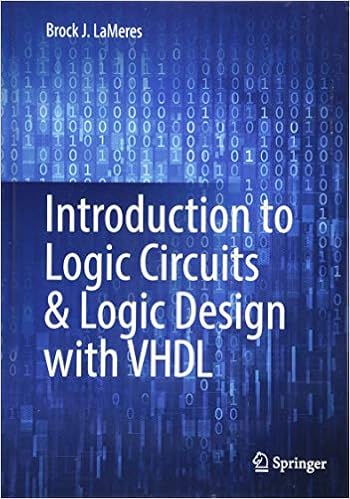
Introduction to Logic Circuits & Logic Design with VHDL

Ebook Introduction to Logic Circuits & Logic Design with VHDL
Feel woozy of your deadline task? It appears that you need enhancement sources and also motivations, don't you? Do you like reading? What kind of reading materials you may possibly like to do? We will certainly show you Introduction To Logic Circuits & Logic Design With VHDL as one of the advised books that will remain in this place. As recognize, this internet is preferred with all great publications in soft file version. When you have suggestions to earn handle this book, it must be promptly done.
To fulfil the people need regarding getting the book, we offer this internet site to visit. Not just to see, can you also be the member of this website to get the new upgraded publication everyday. As here, we will certainly offer to you as the very best Introduction To Logic Circuits & Logic Design With VHDL today. It is extremely interesting to disclose that many people love reading. It implies that the needs of the books will certainly boost. Yet, how has to do with you? Are you still spirit to finish your reading?
To prove exactly how this publication will certainly influence you to be better, you could begin reviewing now. You may likewise have known the writer of this publication. This is a very impressive publication that was created by professional author. So, you could not feel question of Introduction To Logic Circuits & Logic Design With VHDL From the title and also the writer added the cover, you will certainly be sure to review it. Even this is a simple book, the material is very important. It will certainly not should make you feel dizzy after checking out.
So, just how about the method to get this publication? Easy! When you could enjoy reading this publication while chatting or only sitting somewhere, you could utilize your time completely. Obviously, it will certainly reduce you to recognize as well as get the material of Introduction To Logic Circuits & Logic Design With VHDL rapidly. When you have more time to review, naturally you could finish this book in just little time, as compared to the others. Some people could just get minority mins to review each day. However, when you could make use of every leisure to review, you could get better idea and also fast understanding.
Review
“Effectively for the undergraduate courses the book can serve the good purpose to understand the digital terminology and logic circuit design. … this book is good for beginners and students to understand the digital concepts and basics of VHDL programming.†(Amazon.com, November, 2016)
Read more
From the Back Cover
This textbook introduces readers to the fundamental hardware used in modern computers. The only pre-requisite is algebra, so it can be taken by college freshman or sophomore students or even used in Advanced Placement courses in high school. This book presents both the classical approach to digital system design (i.e., pen and paper) in addition to the modern hardware description language (HDL) design approach (computer-based). This textbook enables readers to design digital systems using the modern HDL approach while ensuring they have a solid foundation of knowledge of the underlying hardware and theory of their designs. This book is designed to match the way the material is actually taught in the classroom. Topics are presented in a manner which builds foundational knowledge before moving onto advanced topics. The author has designed the content with learning goals and assessment at its core. Each section addresses a specific learning outcome that the learner should be able to “do†after its completion. The concept checks and exercise problems provide a rich set of assessment tools to measure learner performance on each outcome. This book can be used for either a sequence of two courses consisting of an introduction to logic circuits (Chapters 1-7) followed by logic design (Chapters 8-13) or a single, accelerated course that uses the early chapters as reference material.Written the way the material is taught, enabling a bottom-up approach to learning which culminates with a high-level of learning, with a solid foundation;Emphasizes examples from which students can learn: contains a solved example for nearly every section in the book;Includes more than 600 exercise problems, as well as concept check questions for each section, tied directly to specific learning outcomes.
Read more
See all Editorial Reviews
Product details
Hardcover: 475 pages
Publisher: Springer; 1st ed. 2017 edition (September 16, 2016)
Language: English
ISBN-10: 3319341944
ISBN-13: 978-3319341941
Product Dimensions:
7.5 x 1 x 10.5 inches
Shipping Weight: 2.6 pounds (View shipping rates and policies)
Average Customer Review:
4.2 out of 5 stars
3 customer reviews
Amazon Best Sellers Rank:
#671,416 in Books (See Top 100 in Books)
This book lays out the concepts and uses of VHDL better than any other textbook of its kind. It's easy to follow and one of the rare textbooks that are easy to read. It's not just page after page of dry technical reading. If you're looking for a book to learn VHDL this is the one to buy.
Chapter 1 to Chapter 3: Lot of emphasis is given by the authors to cover the basic fundamentals required for the design. Chapter 1 to 4 has the many concept check examples and exercises with meaningful questions. But still it lacks the practicality and clarity of explanation. The application of the logic gates and the practical scenarios need to be discussed in more details during the next edition. The current industrial standard is low power designs and voltage levels are less than 5 Volt and even 3.3, 2.8 and 1.5 volt. This need to be mentioned in the section 3.3 with the noise margin and driving loads. Effectively for the undergraduate courses the book can serve the good purpose to understand the digital terminology and logic circuit design.Chapter 4 discusses about the combinational logic design and author has covered the concepts in detail with the minimization techniques. For the further improvement in this book, authors can think about adding the area optimization techniques, the parallel logic and concurrent logic and the design performance. Even for better readability the medium complex examples need to be discussed in this chapter.Chapter 5 has information about the basic of VHDL and with reference to the initial chapters the emphasis is given to implement the logic structure. This chapter has VHDL codes for some functionality. Still it lacks the basic difference between structural, behavior and RTL description. For small density logic the approach explained by the authors is good but as design complexity increases the approach is not suitable. So during the next edition it is better to add the different types of VHDL abstractions with the examples.Chapter 6 has VHDL codes and it lacks the naming conventions followed in the practical world. Even the sequence should be MUX, Demux, Advantages and disadvantages with VHDL implementations and then use of decoders, encoders. On page 183-184 there is functional issue in the design of encoder and author should correct this. The encoder all inputs are logic “0000†then the output is also “00†in the design. So according to the given VHDL description output is “00†for input “0001†and for when others condition that may be “0000â€. Under such circumstances it is essential to add the status flag functionality to generate flag output as logic ‘1’ when all inputs of encoder are logic ‘0’.Chapter 7 page 255 has the tmargin delay but the cause of the delay is not explained properly. The Process, Voltage Temperature variation or On-chip-variation need to be explained with some practical example then the timing diagram and the maximum frequency calculation section can be more meaningful and readers will be able to correlate the same with the practical scenarios.Chapter 8: VHDL constructs like if-then-else has potential problem in the description. Please check page 271 code first “Due to missing ‘else’ clause it infers the latch. But author has described this as combinational logic. Unnecessary unintentional latches are inferred in the design. In this chapter most of the example lacks the naming conventions. Even the quality of example need to be improved, even there is need to add few practical applications.Chapter 9 has sequential logic VHDL description; still it lacks the difference between the behavior and RTL. The RTL coding should be improved with the meaningful naming conventions and with some additional complex functionality.Chapter 10 and 11 has only theoretical information about the memories and programmable logic and this can be improved with some practical scenarios and with few examples and realization of VHDL into synthesis.Chapter 12 and 13 covers VHDL coding of adders to processor but still the linking of the concept to implement the design is lacking in this. These two chapters can be improved by adding other concepts related with RTL design, synthesis and design implementation using FPGA or ASIC.Overall the book covers many concepts but lacks the practical scenarios and even it lacks the complex example design, synthesis and implementation. But this book is good for beginners and students to understand the digital concepts and basics of VHDL programming.
Excellent textbook!
Introduction to Logic Circuits & Logic Design with VHDL PDF
Introduction to Logic Circuits & Logic Design with VHDL EPub
Introduction to Logic Circuits & Logic Design with VHDL Doc
Introduction to Logic Circuits & Logic Design with VHDL iBooks
Introduction to Logic Circuits & Logic Design with VHDL rtf
Introduction to Logic Circuits & Logic Design with VHDL Mobipocket
Introduction to Logic Circuits & Logic Design with VHDL Kindle


Tidak ada komentar:
Posting Komentar