Ebook Download How We Got to Now: Six Innovations That Made the Modern World
So, when you actually require the info and also knowledge related to this topic, this publication will be truly perfect for you. You might not feel that reading this book will certainly offer heavy thought to believe. It will certainly come relying on how you take the message of guide. How We Got To Now: Six Innovations That Made The Modern World can be really an option to complete your task on a daily basis. Even it won't end up after some days; it will certainly provide you a lot more significance to expose.
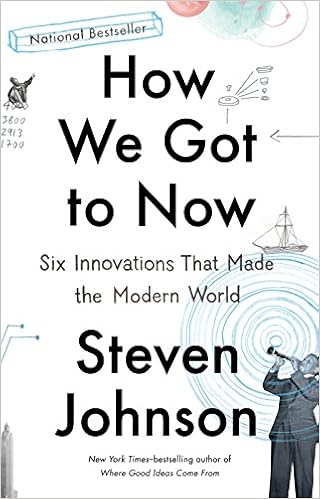
How We Got to Now: Six Innovations That Made the Modern World

Ebook Download How We Got to Now: Six Innovations That Made the Modern World
How We Got To Now: Six Innovations That Made The Modern World. Discovering how to have reading routine is like learning to try for consuming something that you really do not want. It will certainly need more times to assist. Additionally, it will also little pressure to serve the food to your mouth as well as ingest it. Well, as reading a publication How We Got To Now: Six Innovations That Made The Modern World, sometimes, if you need to check out something for your new works, you will certainly really feel so lightheaded of it. Also it is a publication like How We Got To Now: Six Innovations That Made The Modern World; it will make you really feel so bad.
There are numerous publications that can be the way for getting to the brighter future. It will additionally feature the numerous styles from literary fiction, socials, business, religious beliefs, regulations, and also several various other publications. If you are confused to pick among the books, you could attempt How We Got To Now: Six Innovations That Made The Modern World Yeah, this book ends up being a much recommended book that lots of people love to read, in every problem.
When accelerating as well as advertising this book we are also so sure that you can get the lesson and understanding quickly. Why? With your basic expertise and also ideas, your choice to mix with the lessons provided by this publication is really incredible. You can find the ideal option of how today publication in this lesson is acquired. As well as now, when you are actually discover of this type of book topic, you could gain the documents of guide in this rest.
Obtain the link to download this How We Got To Now: Six Innovations That Made The Modern World and also begin downloading. You can want the download soft documents of the book How We Got To Now: Six Innovations That Made The Modern World by undergoing various other tasks. And that's all done. Now, your turn to check out a publication is not constantly taking as well as carrying the book How We Got To Now: Six Innovations That Made The Modern World almost everywhere you go. You can conserve the soft documents in your device that will certainly never be far and also review it as you like. It is like checking out story tale from your device then. Currently, start to like reading How We Got To Now: Six Innovations That Made The Modern World as well as get your new life!
Review
Praise for Steven Johnson “A great science writer.” — Bill Clinton, speaking at the Health Matters conference “Mr. Johnson, who knows a thing or two about the history of science, is a first-rate storyteller.” — The New York Times“You’re apt to find yourself exhilarated…Johnson is not composing an etiology of particular inventions, but doing something broader and more imaginative…I particularly like the cultural observations Johnson draws along the way…[he] has a deft and persuasive touch…[a] graceful and compelling book.” — The New York Times Book Review “Johnson is a polymath. . . . [It’s] exhilarating to follow his unpredictable trains of thought. To explain why some ideas upend the world, he draws upon many disciplines: chemistry, social history, geography, even ecosystem science.” — Los Angeles Times“Steven Johnson is a maven of the history of ideas... How We Got to Now is readable, entertaining, and a challenge to any jaded sensibility that has become inured to the everyday miracles all around us.” — The Guardian“[Johnson's] point is simple, important and well-timed: During periods of rapid innovation, there is always tumult as citizens try to make sense of it....Johnson is an engaging writer, and he takes very complicated and disparate subjects and makes their evolution understandable.” — The Washington Post “Through a series of elegant books about the history of technological innovation, Steven Johnson has become one of the most persuasive advocates for the role of collaboration in innovation….Mr. Johnson's erudition can be quite gobsmacking.” – The Wall Street Journal “An unbelievable book…it’s an innovative way to talk about history.” — Jon Stewart"What makes this book such a mind-expanding read is Johnson’s ability to appreciate human advancement as a vast network of influence, rather than a simple chain of one invention leading to another, and result is nothing less than a celebration of the human mind." — The Daily Beast“Fascinating…it’s an amazing book!” — CBS This Morning “A full three cheers for Steven Johnson. He is, by no means, the only writer we currently have in our era of technological revolution who devotes himself to innovation, invention and creativity but he is, far and away, the most readable.” — The Buffalo News "The reader of How We Got to Now cannot fail to be impressed by human ingenuity, including Johnson’s, in determining these often labyrinthine but staggeringly powerful developments of one thing to the next." — San Francisco Chronicle"A rapid but interesting tour of the history behind many of the comforts and technologies that comprise our world." — Christian Science Monitor"How We Got to Now... offers a fascinating glimpse at how a handful of basic inventions--such as the measurement of time, reliable methods of sanitation, the benefits of competent refrigeration, glassmaking and the faithful reproduction of sound--have evolved, often in surprising ways." — Shelf Awareness "[Johnson] writes about science and technology elegantly and accessibly, he evinces an infectious delight in his subject matter...Each chapter is full of strange and fascinating connections." — Barnes and Noble Review"From the sanitation engineering that literally raised nineteenth-century Chicago to the 23 men who partially invented the light bulb before Thomas Edison, [How We Got to Now] is a many-layered delight."— Nature Review“A highly readable and fascinating account of science, invention, accident and genius that gave us the world we live in today.” —Minneapolis Star Tribune
Read more
About the Author
Steven Johnson is the bestselling author of eleven books, including Where Good Ideas Come From, Wonderland, and The Ghost Map. He's the host and co-creator of the Emmy-winning PBS/BBC series How We Got To Now, and the host of the podcast American Innovations. He lives in Brooklyn and Marin County, California with his wife and three sons.
Read more
See all Editorial Reviews
Product details
Paperback: 320 pages
Publisher: Riverhead Books; Reprint edition (September 22, 2015)
Language: English
ISBN-10: 1594633932
ISBN-13: 978-1594633935
Product Dimensions:
6 x 1 x 9 inches
Shipping Weight: 1.1 pounds (View shipping rates and policies)
Average Customer Review:
4.6 out of 5 stars
562 customer reviews
Amazon Best Sellers Rank:
#29,591 in Books (See Top 100 in Books)
I find it interesting to read the history of trends and technology that have impacted our lives, enjoy it even more when it is delivered in energetic and amusing fashion. Beyond the "butterfly effect" wherein the interaction of the air of the flap of wings of a butterfly in California, say, leads to the formation of a storm in the Atlantic. While this is an interesting aspect of chaos theory, the author prefers the "hummingbird effect" where the changes in on thing can be directly linked to another like the role of pollen on hummingbird flight patterns and wing development. This effect the author puts to use to describe "strange chains of influence" where "innovation or cluster of innovations, in one field ends up triggering changes that seem to belong to a different domain altogether." An example is the development of printing by Gutenberg leads to the availability of books which leads to an awareness of a need for spectacles to see small items clearly which leads to the development of artisans working glass and the development of specialized lenses which leads to microscopes and telescopes which leads to advancements in science and health which reverberate today. Johnson analyses 6 major areas of development glass, cold, sound, clean, time and light. The book is full of interesting anecdotes - the New Englander who thought he could make a fortune delivering ice to the tropics only to find once he got there that no one wanted it. Or the Frenchman who invented a method of recording sound long before Edison's phonograph and who would be honored today but for one problem - he forgot about playback! The author posits that most inventions tend to arise in clusters based on where current practice and technology exist in the "adjacent possible". But he also notes that some "time travelers" are able to develop ideas long before they can be put to practical use a la Babbage and his analytical engine and Ada Lovelace's designs for computer programming, DaVinci and his helicopters, etc. The book is well illustrated, moves at a rapid clip and is an amusing and educational read.
Random knowledge is sort of my thing. I am somewhat fixated on knowing a little about a lot. The world is so vast and there is so much information out there.Though we may deem some knowledge as random, no knowledge is truly random when you pull back far enough. Everything is interconnected in some way and many times they are connected in very unexpected ways.In How We Got to Now by Steven Johnson you get a fascinating image of our world. The butterfly effect is a popular notion used to describe how one seemingly arbitrary event can have a significant impact across the planet. Johnson, however, uses a more accurate and more powerful notion: the hummingbird effect. As he puts it, we can understand a world with flowers but no hummingbirds, but we cannot comprehend a world with hummingbirds but no flowers. The anatomy of a hummingbird exists because the flower exists, the flower does not depend on the hummingbird.Technology is similar to a hummingbird, most technologies could not exist without something else. Ideas for computers, batteries, and engines have been around for ages but without existing technology the ideas had to stay dormant.This book is flat out one of the most interesting books I have ever read. It is amazing how simple ideas have given way to technological revolutions. It is amazing to see how much technology has evolved in a matter of two centuries. For millennia light only came in one form: fire. For millennia information only travelled at the speed of a man’s gait. For millennia a man never saw his reflection. Today, that and so much more has changed.It is so easy to forget how simple innovations have changed the world, and it is easy to forget how much the world has changed.
What a fascinating book! If you like entertaining and interesting, well-written, well-researched, journalist-style non-fiction history, you will be sure to enjoy this. It takes six innovations (glass, clean, light, cold, sound, time) through history, including all the inventors and all the quirks of history that led to the modern day use of these innovations. For instance, glass starts with a meteor strike in the Egyptian desert that results in an extremely rare substance in nature (sand turned to glass in extreme heat) - so rare that it was used in an ornament in King Tut's tomb -- through to the present day use of it virtually everywhere, including, of course, fiber optics. Each chapter is a fascinating journey, filled with interesting, quirky, and brilliant inventors and odd juxtapositions. (The invention of the printing press led to the widespread use of reading material, which made many people realize for the first time that they needed reading glasses). It is in the general genre of Mary Roach (though not as hilarious), Malcolm Gladwell, and Steven Jay Gould. In other words, science and history for the interested, educated, but non-expert reader. You will be sure to bore your friends with all sorts of little factoids gleaned from this book for some time.
How We Got to Now: Six Innovations That Made the Modern World PDF
How We Got to Now: Six Innovations That Made the Modern World EPub
How We Got to Now: Six Innovations That Made the Modern World Doc
How We Got to Now: Six Innovations That Made the Modern World iBooks
How We Got to Now: Six Innovations That Made the Modern World rtf
How We Got to Now: Six Innovations That Made the Modern World Mobipocket
How We Got to Now: Six Innovations That Made the Modern World Kindle


Tidak ada komentar:
Posting Komentar